
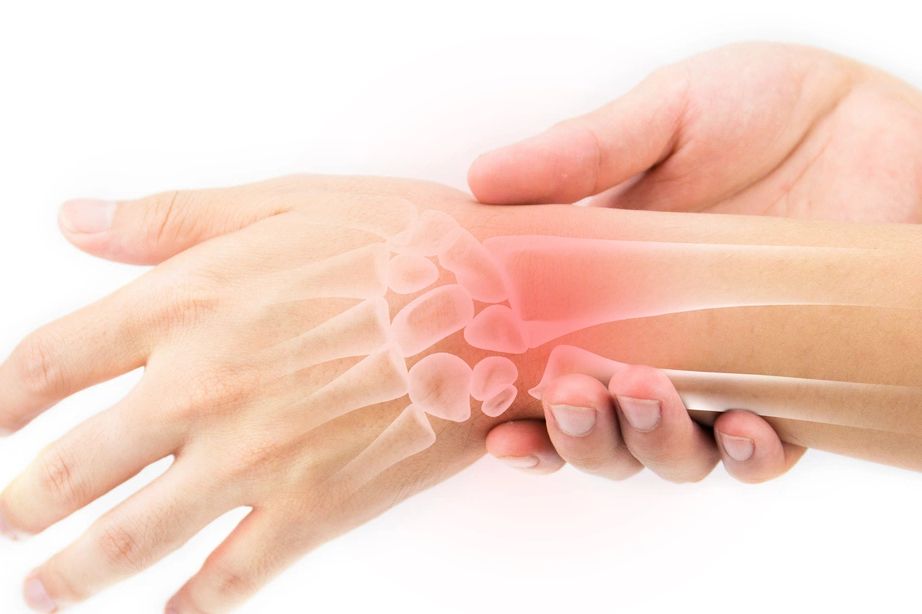
Wrist pain or issues with reaching a full range of motion can be resulted with a variety of causes.
To understand better the causes for the pain or mobilization issue, let’s first have a look on the structure of the wrist bone wise, tissue wise and also, nerve wise. Our wrist is built of 13 bones, 8 Carpal Bones form the base of the wrist itself and connect the arm and hand, moving to the arm we’ve got the Radius and Ulna connecting the Carpal Bones and going to the hand we’ve got 5 Metacarpal Bones that begin the structure of our hand. Tissue wise, we’ve got going through the wrist both the Wrist Extensors (8 muscles) and Wrist Flexors (6 muscles), which sum up to a total of 14 muscles going through the joint. If we inspect the Nerve System, the wrist has 3 major nerves that passes through, the Median, Ulnar and Radial nerves.
As you would have already guessed, wrist pain can be caused by either muscle ache or nerve pressure along with dislocated or fractured bone as “easy” causes, and it can also be resulted as a combination of elements from all the structural components of the delicate joint.
We’d start from simple cases and move on to more complex pain causes, taken from my experience as a manual therapist and a trainer. I would not dive deep into the names and precise locations of each bone and muscle but would address the overall groups as Carpal bones, Metacarpal Bones, Wrist Extensors, Wrist Flexors, and so on depending on the group, if I’d have a first reference, I would explain a bit of the structure, but would not dig in too much, should you have specific questions, feel free to contact me privately.
Musclar Causes
The most simple cause of pain, is pain caused by tight, short and sore wrist Extensors and / or Flexors. Personally, I come across Flexor caused pain more, and that is because most of us usually hold things and tighten our fist, which is a Flexors function, so while we carry groceries, lift weights or even hold our cup to drink, we use them, we usually start to feel the pain while leaning on the wrist, which supplies a pretty good stretch for the Flexors as both the fingers and the hand are entering an extended position.
However, don’t be fooled that the Flexors cause the pain alone, our body is always striving to achieve homeostasis state, which for the wrist means that the bones would keep their neutral natural positioning. If the Flexors are tight and are pulling both the hand and the fingers towards them, forcing a fist and flexion of the wrist, the Extensors would pull back to fix the wrist and fingers back to neutral point. This type of action can cause early fatigue and sore feeling of the forearm, as the Extensors are working hard to undo the Flexors pull due to shortness or tightness. This pull on both ends of the wrist can cause a dysfunction with the wrist’s mobility and reduce the range of motion while causing pain and weakness on daily tasks.
Important to note that the chain of events can begin with the Extensors as well and result with the same feeling, every case should be examined individually.
Why is this the most simple cause of pain? Well, the correction is easy, you could either stretch the area to relief muscle pull and lengthen issue causing muscle, or go to a manual therapist to treat the muscles and tissues to a more eased state.
Bone Causes
Personally, as a teen I’ve had a slight Ulnar Dislocation, it was hardly noticeable, since it was first thought to be an inflammation and was treated the same, but when the treatment did not work and the pain remained I had it looked by several doctors and physiotherapists until one saw that at a pushup position my Ulna seems to go higher than it should. 8 months of daily pain due to a slight movement of the bone structure.
I guess you wonder why I’ve started with that short personal story, well, I think it’s a great example of how even the tiniest of movements in the bone structure can cause a lot of pain, and it was a great intro for bone causes.
As mentioned at the beginning, the wrist is built of 13 bones, and as shown in the personal story, you don’t need more than a single bone to be slightly away for the whole structure to “collapse”.
If you’ve had a force trauma to your hand, can be a slip that was prevented with your hand contacting a flat surface or a fast ball that was stopped with your hand before hitting or scoring a goal, the ways of receiving the trauma vary and are not always in our mind when we start to feel the pain. Do yourselves a favour, and check the structure to prevent worsening in your condition.
The Bone causes are second on my list, because even though they might require a bit more care while treating and a certified professional, they are still easier to track than Nerve Causes.

Nerve Causes
Last but not least, the Nerve Causes. In the image to the left you may find the 3 nerves mentioned in the beginning of this article high lighted through the arm, forearm and hand. Those nerves originate at the neck and go all the way through to our fingers.
So why did I list these as a hardest cause? Well, due to their length and many muscles surrounding them, the slightest tension applied on either of them can result with pain or issues with range of motion or strength control of the wrist.
A trauma to the neck can result later on with wrist pain, a strong shoulder or arms exercise can be a cause of wrist pain, poor positioning of the arm while performing daily chores can result with wrist pain, and so on.
A trauma to the neck can result later on with wrist pain, a strong shoulder or arms exercise can be a cause of wrist pain, poor positioning of the arm while performing daily chores can result with wrist pain, and so on.
I’ve heard of cases where Carpal Tunnel Syndrome was poorly diagnosed due to pressure originating from the neck muscles that are in proximity to the nerves and have applied pressure that skipped the shoulder, arm and forearm and reached straight to the wrist.
A Nerve caused pain can be tricky and handled with care, it is important to bare in mind that the result may take time, as the pressure point resulting with the nerve malfunction can be found through various places and is dependent of daily movements done, along with the original trauma cause, followed by the body’s compensation to ease motions and tasks while using a different set of muscles to achieve the same goal.
I hope this has clarified some of the causes for your pain, all the described information above is relaying on my experience and knowledge. Refer to a certified professional should you start to experience pain. If you have specific questions or want to dig deeper into a topic, feel free to contact me, if you’ve found an error through the article, let me know as well so it would be corrected shortly.